Conveyor systems — UK specification, installation and support01494 623015 · sales@lancinguk.com

Motor-driven roller guide

24V Motorised Roller Conveyors: Zones, Controls and Selection

Understand how motorised rollers, driven idlers, product sensors and zone logic work together before selecting a controlled roller-conveyor architecture.

Powered roller conveyor used for motorised roller zone and control guidance
Engineering guidance for powered conveyor projects
Supportprove the product base
Zonesdefine detection and release
Controlsagree blocked and fault states

Direct answer

What is a 24V motorised roller conveyor?

A 24V motorised roller conveyor uses a low-voltage motor built into selected conveyor rollers to drive one or more rollers within a controlled zone. Product sensors and zone controllers can start, stop, hold and release loads according to the chosen logic. The conveyor must still be specified mechanically: the load base, roller pitch, zone length, transfer support and environment determine whether the product can be handled reliably.

“Motorised roller”, “motor-driven roller” and “MDR” are commonly used for this architecture. The exact voltage, torque, speed, protection rating, controller and permissible load are properties of the selected components and must be confirmed from current manufacturer data rather than assumed from the category name.

Zone architecture

How do motorised roller conveyor zones work?

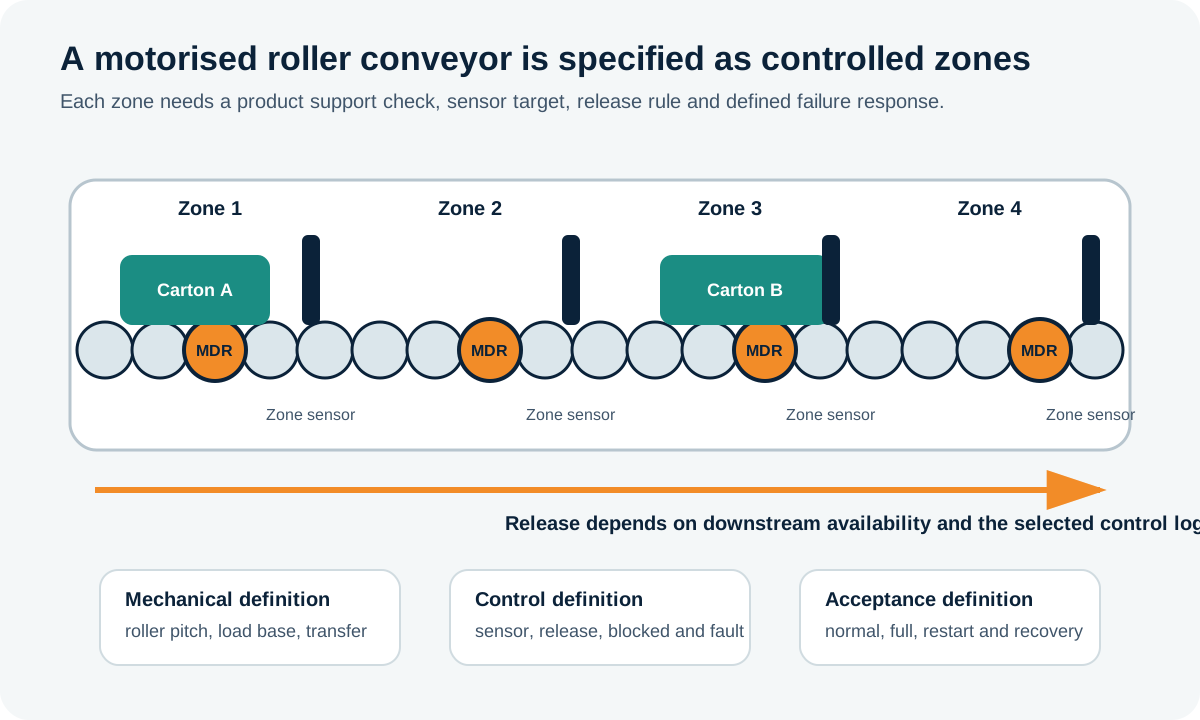
A zone normally combines a motorised roller, linked idler rollers, a product sensor and a control function. The control decides whether the zone can accept or release a product by evaluating local occupancy and the downstream state. The mechanical and control definitions must use the same zone boundaries.

Four-zone motorised roller conveyor architecture with sensors, drive rollers and downstream release logic
Zone length is a control and product-handling decision. It is not simply the distance between two convenient sensors.

Official component documentation should be checked during selection. As examples of the architecture, Interroll describes a RollerDrive as a roller with an integrated drive and its ZoneControl as a controller for zero-pressure accumulation. Review the official RollerDrive overview and ZoneControl overview. These references illustrate component principles; they do not define the final Lancing project specification.

Selection framework

What must be specified for a motorised roller conveyor?

DecisionWhat to establishWhy it changes the design
Product supportShortest rigid base, underside condition, mass distribution and permitted orientation.Controls roller pitch, number of supporting rollers and transfer detail.
Zone functionTransport, metering, accumulation, workstation hold, merge, divert or transfer.Determines zone length, sensing, release logic and accepted contact between products.
Sensor targetMaterial, colour, transparency, label position, height and the target presented in every format.A zone cannot be controlled reliably if occupancy is not detected consistently.
Release modeSingle release, train release, timed metering or higher-level PLC instruction.Changes product spacing, throughput, downstream interaction and recovery behaviour.
Drive dutyLoad, start frequency, incline, speed range, acceleration and accumulation state.Defines the required motorised roller, transmission to idlers, controller and power supply.
InterfacesUpstream product-present or run-permit signals, downstream-ready signals and fault ownership.Prevents products being released into a stopped or unavailable machine.
EnvironmentTemperature, contamination, cleaning method, corrosion risk and ingress exposure.Controls component materials, protection, accessibility and maintenance method.

Zero-pressure accumulation

What is zero-pressure accumulation?

Zero-pressure accumulation is a control method that holds products in separate zones so they do not intentionally push against one another while waiting. A product occupies a zone, the controller checks downstream availability and the zone releases according to the defined logic. The description does not guarantee zero physical contact under every fault or product condition; zone length, sensing, braking, overrun and recovery must still be tested.

Use the accumulation conveyor guide to determine the required interruption time and product positions. Use the sensor and controls integration guide to define signal ownership and failure responses.

Technology choice

When should 24V motorised rollers be compared with other conveyors?

Motorised roller zones are a strong option when rigid-based unit loads need controlled spacing, accumulation or independent sections. Compare alternatives when product support, cleaning, environment, contact behaviour or control complexity point elsewhere.

Compare a continuous powered roller drive

A continuous driven roller arrangement may be simpler where products only need transport and low-pressure flow. Compare energy architecture, maintenance, accumulation behaviour and fault isolation rather than assuming the more segmented option is automatically better.

Compare a belt conveyor

A belt provides continuous base support for short, flexible, irregular or soft-bottomed products. It may also simplify a transfer where a roller gap cannot support the smallest product.

Compare a slat-chain conveyor

Guided bottles and jars, especially around compact curves, may suit a slat-chain route. Container stability, guide pressure, accumulation contact and cleaning remain application-specific.

Compare a gravity section

A gravity conveyor may be suitable where manual input, controlled slope and product behaviour make positive drive unnecessary. The ergonomic, stopping and interface risks still need assessment.

For a neutral comparison of driven and unpowered handling, see motorised versus gravity conveyors.

Project schedule

What information is needed for a 24V roller conveyor quotation?

Provide the complete product range, underside photographs, minimum and maximum mass, route, interface heights, required operating states, intended accumulation, power/control boundary and site environment. Where a particular component platform is mandatory, identify it together with the required communications and approved supplier data.

Download motorised roller zone schedule

Buyer questions

24V motorised roller conveyor questions

Does every roller contain a motor?

Not necessarily. A motorised roller commonly drives adjacent idler rollers within a zone through a selected transmission method. The number of driven rollers and permissible duty depend on the component platform and load.

Is every 24V roller conveyor zero-pressure accumulation?

No. A 24V drive architecture can be used for continuous transport or controlled zones. Zero-pressure accumulation requires suitable sensing, zone control, product spacing and release logic.

How is a motorised roller zone length chosen?

Zone length is based on product envelope, spacing, sensor position, braking or overrun, transfer location and release strategy. It should be verified with the full product range.

Can transparent or dark products be detected?

They may require a sensor technology and mounting arrangement selected for the actual target and background. Detection should be tested with every relevant label, colour, orientation and surface condition.

Can motorised roller conveyors run on an incline?

Component suppliers may permit limited incline duties, but the product, load, braking, rollback risk, drive capacity and restart condition require application-specific assessment. Do not assume a horizontal zone design can be tilted unchanged.

What happens if a downstream machine stops?

The conveyor should enter the defined blocked state, stop releasing products into the unavailable interface and recover according to an agreed sequence. The required buffer and signal ownership must be specified between the connected systems.

Roller-conveyor review

Define each zone before selecting components.

Send the product base, load, route, accumulation need, sensor target, control interface and operating environment so Lancing can review the appropriate roller-conveyor approach.

Send conveyor details