
Preserve product state
Where practical, the controls should retain or safely re-establish which zones contain product and which interface is blocked.
Production-flow engineering
Measure good product through the complete line, then reduce starvation, blocked time, unstable spacing and slow recovery before asking the conveyor to run faster.

Direct answer
Conveyor throughput is improved by increasing the density and availability of accepted product flow, not merely by increasing belt or roller speed. Measure where the line is starved, blocked, stopped or recovering; stabilise product induction and pitch; use accumulation only where it absorbs a defined interruption; and coordinate machine states so products are released when the next process can accept them.
The useful output measure is good product through the complete process over a representative period. A conveyor that runs continuously can still contribute little if it carries large gaps, waits for upstream product or repeatedly releases into a blocked transfer.
Flow states
A downstream process is starved when it is ready but has no acceptable product to process. An upstream process or conveyor is blocked when it cannot release product because the next stage is unavailable. A balanced line reduces both conditions and recovers predictably after a planned or fault stop.
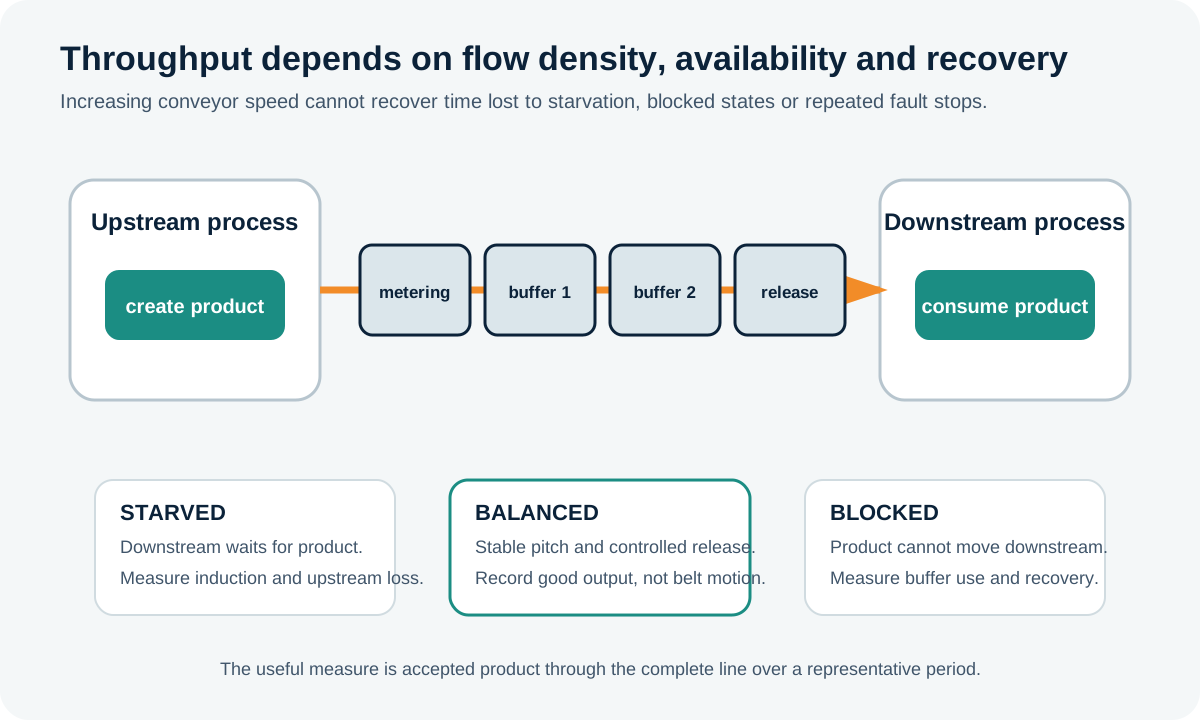
Measurement sequence
Balance the line by following the product through each stage, recording good output and lost states, then testing the smallest change that removes the controlling constraint without transferring the problem downstream.
Product pitch and speed
For a stable single-lane flow, the initial theoretical relationship is products per minute = conveyor surface speed in metres per minute ÷ product pitch in metres per product. Product pitch includes the product length in the travel direction plus the intentional gap. The calculation is only a starting point because induction variation, acceleration, sensing, transfers, rejection and process stops reduce usable output.
| Observed condition | Why extra speed may not help | Evidence-led action to assess |
|---|---|---|
| Large, irregular gaps at infeed | Higher speed carries the same empty spaces faster and may increase variation. | Stabilise induction, metering or release timing and measure pitch distribution. |
| Downstream machine repeatedly blocked or faulted | The line cannot accept additional product during unavailable periods. | Address the process fault, blocked-state logic and recovery sequence. |
| Product tips or jams at transfer | Higher speed may reduce transfer time and increase impact or instability. | Review support, height, guide transition, acceleration and representative trials. |
| Buffer fills but does not release cleanly | Capacity exists, but sensing or release logic prevents useful flow. | Check zone occupancy, product contact, sensor state and downstream-ready logic. |
| Operators cannot replenish or clear the station | The limiting task is ergonomic or manual rather than conveyor speed. | Review workstation design, product presentation and safe staffing requirement. |
| Drive or product behaviour approaches a limit | More speed can reduce margin for starting, stopping, detecting and controlling the load. | Reassess the complete mechanical and control duty with selected component data. |
Use the conveyor speed control guide for the basic speed/pitch calculation and the engineering calculations guide for units and assumptions.
Accumulation decision
Accumulation improves useful throughput when it absorbs a known mismatch or short interruption and releases products in a controlled way after the next process becomes available. It does not remove a persistent downstream capacity shortfall. If the buffer reaches full capacity during normal running and stays full, the underlying line constraint remains.
Define buffer time from the real interruption, product positions, contact limits and recovery rule. See the accumulation conveyor guide and accumulation conveyor options.
Control and recovery
A short fault can create a long production loss if products must be removed, zones lose occupancy, machines reset in the wrong order or upstream equipment restarts before the downstream path is ready. Define the recovery state as carefully as normal running.
Where practical, the controls should retain or safely re-establish which zones contain product and which interface is blocked.
Confirm downstream availability before releasing accumulated product and avoid a surge that immediately recreates the fault.
Record time from fault clearance to stable good output. A fast reset button is not the same as fast production recovery.
Use the sensor and controls integration guide and the downstream-stop question guide to define states and signal ownership.
Data worksheet
Record each process stage, product format, good output, nominal and observed cycle, product pitch, starved time, blocked time, faults, changeover, usable buffer, release rule and the condition that limits recovery. Use a representative production period and separate different formats rather than averaging incompatible conditions.
Buyer questions
Only if conveyor speed is the actual limiting constraint and the product, transfers, sensing, drive, controls and connected processes can accept the new duty. Gaps and unavailable machine time do not disappear when the surface moves faster.
Check how products are inducted, released, detected and accelerated. Metering, controlled zones or a more consistent upstream discharge may reduce variation, but the required gap must still protect transfers and downstream processing.
Capacity is the potential amount a conveyor or process can carry under defined conditions. Throughput is the accepted output achieved over time after stops, gaps, rejects and other losses.
It can absorb a temporary mismatch, but it cannot solve a downstream process whose sustainable capacity remains below the incoming rate. Define the interruption and recovery before increasing buffer length.
Products may lose spacing, buffers may empty or overfill, machines may restart in the wrong sequence, or operators may need to clear faults. Measure recovery to stable good output rather than only stop duration.
No single page or machine should own the decision in isolation. The agreed speed, product pitch, run permits, blocked states and recovery sequence should be documented across the conveyor and connected processes.
Line-flow review
Provide product format, stage rates, pitch, starved and blocked observations, buffer use, fault history and connected-machine signals so Lancing can review the conveyor’s role in the complete line.