
Identify every energy source
Electrical power is only one source. Consider gravity, tension, raised sections, pneumatic or hydraulic energy, moving product and energy transferred from connected machinery.
Machinery safeguarding guidance
Identify the task, hazard, access need and energy source before agreeing guards, interlocks, emergency stops, isolation and handover evidence for a conveyor line.

Direct answer
A conveyor guarding review should identify dangerous moving parts, the tasks that bring people near them, the access genuinely required and the safe state for each intervention. It should then define safeguarding, emergency-stop coverage, isolation, reset and validation for the conveyor and its interfaces with adjacent machinery. The final measures depend on a competent, application-specific risk assessment.
HSE’s PUWER overview states that work equipment should have suitable protective devices and controls, normally including guarding, emergency-stop devices and adequate means of isolation. Read the HSE PUWER overview.
This page provides general project-preparation guidance, not a site-specific risk assessment, legal opinion or declaration of compliance.
Safeguarding workflow
Start from the work people must perform and the reasonably foreseeable interventions, then identify the hazard at each location. Select a measure that controls access without creating an unworkable task, define the safe energy state and verify the completed line under normal and fault conditions.
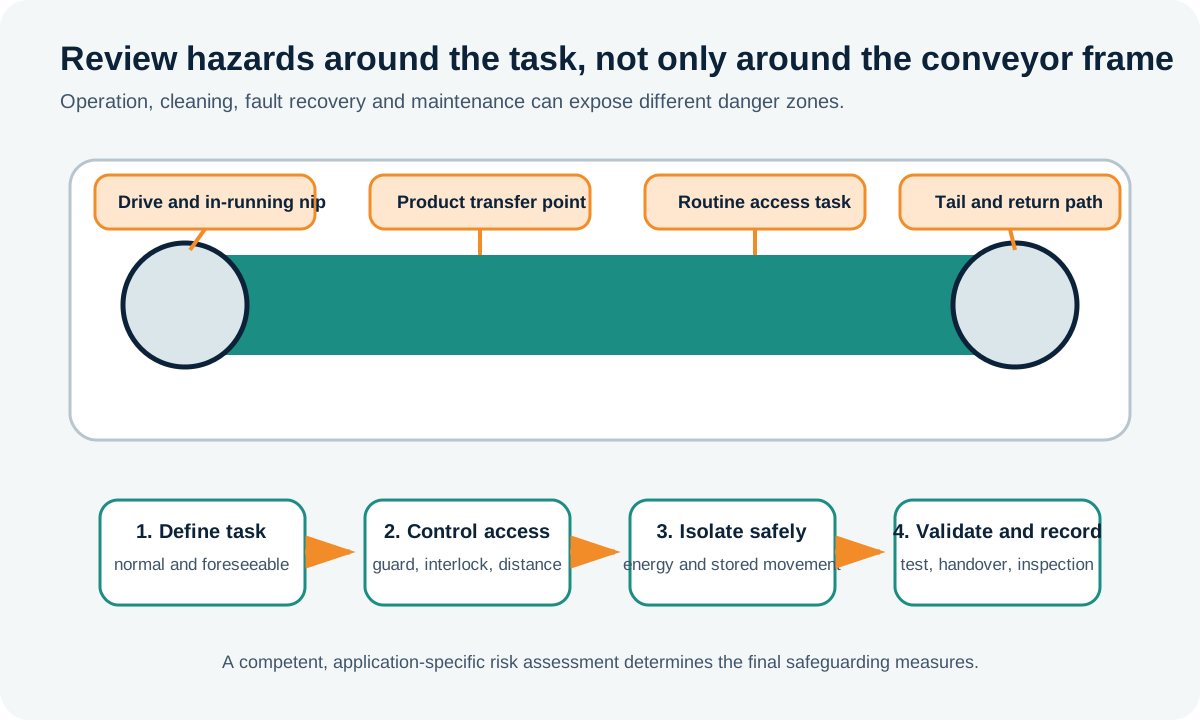
Hazard and task map
| Location or task | Questions to resolve | Evidence required |
|---|---|---|
| Drive, tail and in-running nips | Can a person reach moving parts during normal use, cleaning or fault recovery? | Measured access, guard drawings, fixing or interlock arrangement and validation result. |
| Product transfer between machines | Does the transfer create a nip, shear, crush, trapping or unexpected movement hazard? | Combined layout, relative movement, ownership boundary and safe-access method. |
| Return path and underside | Can rollers, chain, belt or tensioning parts be reached from floor level, a platform or adjacent equipment? | Access-route review, safe distances, guarding and maintenance method. |
| Routine cleaning or inspection | Can the task be completed from outside the danger zone? If access is needed, what state is required? | Cleaning procedure, isolation point, interlock function, retained-energy check and training. |
| Jam and fault recovery | What product condition creates the intervention and how is unexpected restart prevented? | Fault sequence, reset logic, product-removal method and controlled restart test. |
| Adjacent machinery | Can one machine start or create movement while access is controlled by another system? | Safety boundary, interface signals, emergency-stop effects, reset ownership and validation record. |
Guarding and access
No. An emergency stop is a complementary protective measure; it is not a substitute for preventing access to dangerous moving parts. The safeguarding concept should reduce or control access through design, fixed guarding, interlocked access or other suitable measures selected by the competent risk assessment. Emergency-stop devices support intervention when a hazardous situation is developing, but they do not make routine access safe.
HSE guidance explains that effective measures are required to prevent access to dangerous parts and that fixed guarding is normally used, with interlocked guards where routine access is needed. Review HSE safeguarding guidance.
Isolation and maintenance
Safe isolation is the controlled separation of the equipment from energy sources, prevention of reconnection and management of stored or potential movement for the task being performed. The exact method is defined by the site and equipment risk assessment, not by pressing stop or relying on control software alone.
Electrical power is only one source. Consider gravity, tension, raised sections, pneumatic or hydraulic energy, moving product and energy transferred from connected machinery.
Use the approved isolating and lock-off method, prove the safe state where required and control keys, permits and responsibility under the site procedure.
Confirm guards, tools, people, product and connected machines are in the required state before energy is restored and the line is reset.
HSE maintenance guidance states that plant and equipment must be made safe before maintenance starts, including stopping movement and isolating power and other energy sources. Read HSE maintenance guidance.
Combined machinery
Responsibility must be explicitly allocated for the mechanical boundary, safety functions, control signals, guarding, installation and validation. A conveyor supplier can define its equipment scope, but the person or organisation responsible for the completed assembly and the user’s site duties must also be clear. An unowned gap between two contracts is not a safeguarding strategy.
| Interface record | What it should state |
|---|---|
| Mechanical boundary | Final physical interface, support, gap, relative movement and who supplies each guard or cover. |
| Control boundary | Run permits, ready/blocked signals, fault response, reset conditions and ownership of software changes. |
| Safety boundary | Emergency-stop effects, interlocks, stopping behaviour, isolation and validation responsibility. |
| Installation boundary | Fixing, services, access, cable routing, site modifications and coordination of contractors. |
| Handover evidence | Drawings, risk information, test records, instructions, training and outstanding actions. |
Use the sensor and controls integration guide and the FAT/SAT commissioning checklist to record interface and test evidence.
Project worksheet
Keep the task and hazard review, drawings, safeguard specification, isolation method, safety-function description, validation results, inspection method, instructions, training records and controlled changes. The record should identify unresolved actions and the responsible party rather than assuming every item is closed at delivery.
Buyer questions
The required safeguards depend on the dangerous parts, access, tasks and layout. Side panels may control some access but do not automatically address drives, transfers, return paths or connected machinery.
The risk assessment must consider frequency, the fixing or interlock arrangement, run-down, stored energy and how restart is prevented. Routine access may require a different measure from infrequent maintenance access.
The required effect depends on the hazard and combined machinery. Stopping one section can create risk if connected equipment continues, so the safety boundary, stop categories and reset sequence require competent design and validation.
Not automatically. An interlock may stop hazardous movement for access, while maintenance isolation requires a separately defined method to control energy and prevent unexpected restoration.
Reassess access, guards, transfer hazards, cable and emergency-stop reach, stability, isolation, control interfaces and the effect on adjacent equipment. Revalidate affected safety functions and update records.
The site should use a controlled modification process involving people competent in the mechanical, electrical, control and safety consequences. The original risk information and equipment instructions should be considered.
Project preparation
Send the conveyor layout, product route, operator tasks, cleaning method, connected machinery and site constraints so safeguarding responsibilities can be identified during specification.