
Detection reliability
Trial every colour, finish, transparency, label and shape that can change sensor performance. Include gaps, leading edges and the least stable product orientation.
Signals, zones and machine handshakes
Define what each sensor means, which controller owns each action and how upstream and downstream equipment respond to blocked, fault and safe-state conditions.

Control philosophy
A photoelectric sensor does not simply “see a product”. Its control meaning may be product present, zone occupied, downstream blocked, metering position achieved or transfer confirmed. Record the sensing technology, mounting, detection target, expected state, time delays and action on failure. Then identify which controller owns the decision and what information is exchanged with neighbouring equipment.
| Function | Definition to agree | Acceptance observation |
|---|---|---|
| Run permit | Conditions that must be true before the conveyor may start or continue. | Movement is inhibited when a required machine, guard or process condition is unavailable. |
| Ready / available | Whether the signal means powered, fault-free, automatic mode, clear to receive or all of these. | Upstream release occurs only under the documented meaning. |
| Blocked | Sensor position, delay and product condition that represent a downstream restriction. | Upstream flow is held before pressure, tipping or a transfer jam develops. |
| Product transfer | How dispatch and arrival are confirmed across the equipment boundary. | A missing, double or delayed product produces the agreed response. |
| Speed reference | Local setting, fixed recipes, analogue command or network value, including loss-of-reference behaviour. | The conveyor remains within the approved range and recovers predictably. |
| Fault and reset | Which faults are reported, latched, reset locally or reset by a line controller. | A fault cannot be hidden by an automatic restart or an undefined reset path. |
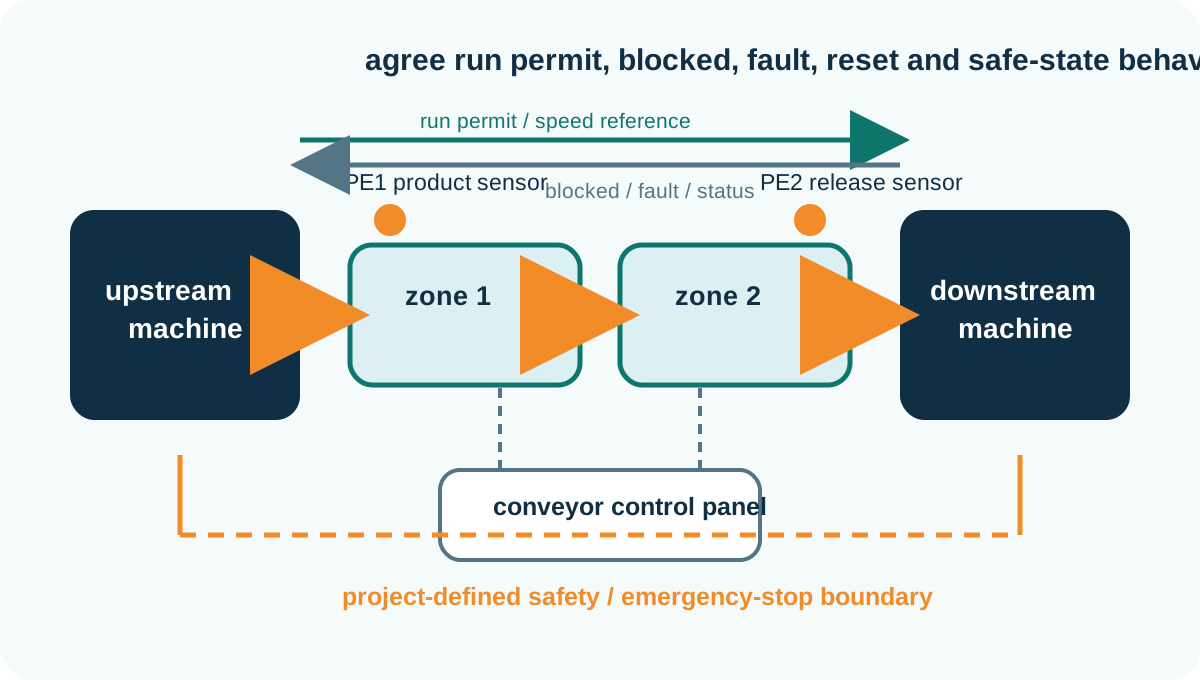
Zone and accumulation logic
For a powered roller or accumulation conveyor, define zone length from the product envelope and required separation rather than from a standard module alone. Specify whether contact is permitted, how products are released, what happens when a sensor remains made and how the line recovers after an emergency stop or power interruption. The control method must match the selected drive and sensor hardware.
Trial every colour, finish, transparency, label and shape that can change sensor performance. Include gaps, leading edges and the least stable product orientation.
Document on-delay, off-delay, release gap, acceleration and transfer confirmation. Hidden timing assumptions often become intermittent faults at higher rates.
Define whether zones retain occupancy, re-home, clear manually or restart in sequence after a fault. Avoid uncontrolled simultaneous release.
Downloadable I/O schedule
The schedule should name the signal, source, destination, electrical or network type, normal state, fail-safe or fault state, description, test method and responsible party. It can then support panel design, software review, FAT, installation and SAT without relying on verbal assumptions.
Download conveyor I/O schedule
Combine it with the transfer layout guide, the conveyor line integration page and the FAT and SAT checklist.
Control acceptance
Buyer questions
It depends on the product material, colour, transparency, shape, background, speed, mounting and environment. Representative trials are more reliable than choosing by range alone.
It is a defined condition or signal that allows movement when the required equipment and process states are available. Its exact meaning must be documented for the project.
The response depends on product pressure, accumulation, upstream process and the agreed control philosophy. It may hold one zone, stop upstream equipment or initiate a controlled line stop.
Only if the complete safety-related control system is specifically designed and validated for the required safety function. A standard process PLC signal is not automatically suitable.
Define product state retention, safe mechanical condition, restart authorisation, zone recovery and whether manual clearing is required before production resumes.
Provide the machine sequence, I/O ownership, panel scope, preferred communications, speed-control method, operating modes, fault behaviour and the responsible safety-system designer.
Project review
Send the machine sequence, expected signals, speed control, product formats and fault-recovery requirement for an integrated conveyor review.